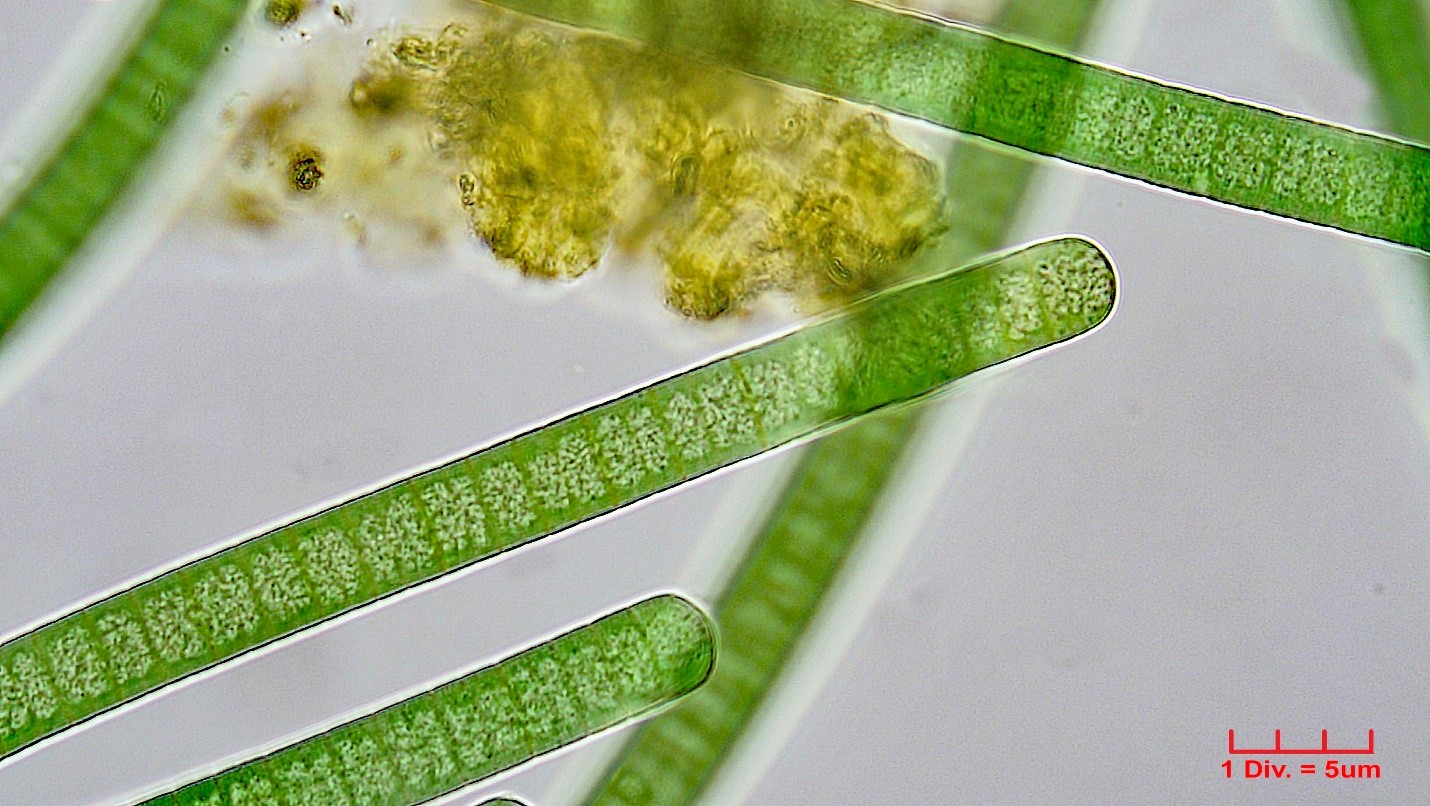
Oscillatoria is a genus of filamentous cyanobacteria. It is often found in freshwater environments. Its name refers to the oscillating motion of its filaments as they slide against each other to position the colony to face a light source. Oscillatoria uses photosynthesis to survive and reproduce. Each filament of Oscillatoria consists of a row of cells called a trichome. The tip of the trichome oscillates like a pendulum.
Reproduction takes place asexually by fragmentation. Usually the filament breaks into a number of fragments called hormogonia. Each hormogonium consist of one or more cells and grows into a filament by cell division in one direction.
As a result of recent genetic analyses, several new genera were erected from this genus, e.g. Tenebriella.
Research
Oscillatoria are the subject of research into the natural production of butylated hydroxytoluene (BHT), an antioxidant, food additive, and industrial chemical.
Cyclic peptides called venturamides, which may have anti-malarial activity, have been isolated from bacteria in this genus. They are the first peptides with this activity to have been found in cyanobacteria.
Serinolamide A is a cannabinoid structurally related to Anandamide that has been found to occur in Oscillatoria species.
Species
Oscillatoria contains the following species:
References
- http://faculty.mdc.edu/jmorata/Slide Study Gyomamauide.pdf
External links
- https://web.archive.org/web/20160304055858/http://133.25.19.145/pdb/images/Prokaryotes/Oscillatoriaceae/Oscillatoria/index.html